
Skip to content

Case Study

Notch Hill Locomotive Wheel Noise Study

Year Completed

2000
About This Project

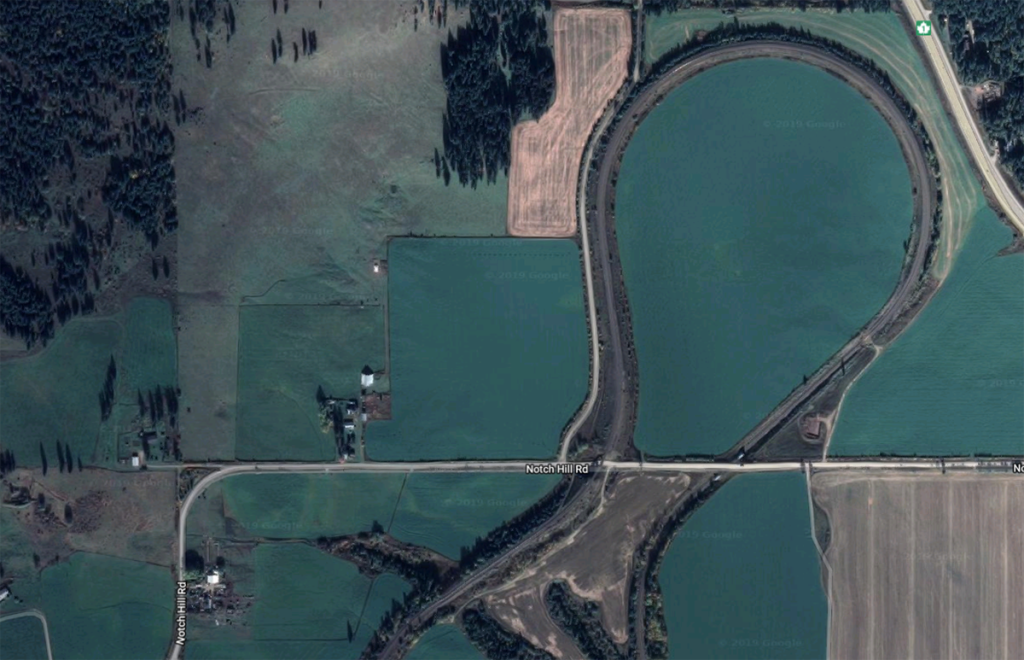
Outside Salmon Arm, BC, trains travelling west on the Canadian Pacific Railway ascend Notch Hill, a 1 degree incline with a 6 degree–radius horseshoe curve. The curve is so tight that a longer train will pass by its own railcars after turning the corner.

In 1995, CP Rail introduced new General Electric 9500 Series locomotives to haul heavy loads of coal and grain westward to the Port of Vancouver. But when the new diesels took to the rails, residents living near Notch Hill began complaining about annoying ringing noises.

Scope of services

In the summer of 1996, CP Rail hired BKL to investigate the ringing and recommend possible solutions. An acoustician visited Notch Hill and made a series of short- and long-term measurements onboard trains, near the tracks, and in the community. The goal of the study was to identify the source of the nuisance noise, determine its tonal characteristics, and find out if the noise was linked to a specific operating condition. To that end, throughout the study, BKL’s acoustician tracked and analyzed the various train setups, locomotive models, and loads. In addition, BKL compared the measured noise levels to the sound levels allowed under regulatory limits, including regional nuisance noise bylaws.

After gathering substantial data through its on-site assessment, speaking to residents in the community, and meeting with engineers from CP Rail, BKL analyzed its findings and connected the ringing sound to the locomotives’ throttle settings and the locations of lubricators along the track. Additionally, CP Rail engineers identified that one particular lubricator was delivering more grease than others. This lubricator was located near the beginning of the horseshoe curve.

To climb Notch Hill, train engineers had been setting their locomotives to maximum power. BKL’s study found that running the engines at full throttle, along with other factors including increased rail grease, caused the locomotive wheels to slip and spin—and emit that pesky ringing noise.

Project benefits

BKL suggested optimizing the locomotive’s power output on the climb, and when CP Rail implemented the recommendations, the ringing noise ceased. Furthermore, climbing the hill in a lower throttle setting created less wear on tracks and wheels.

The next year, when CP Rail was considering new GM locomotives, they hired BKL to conduct a follow-up study in the community. BKL measured noise from various locomotive configurations, confirmed that noise emissions wouldn’t exceed local bylaws, and then commented on the findings. By conducting two in-depth noise assessments, BKL helped to identify and solve a nuisance noise, while also ensuring ongoing positive relationships between CP Rail and nearby communities.

The People Behind Our Work

Our Technical Leads

  • Mark Bliss
    Mark Bliss

    P.Eng., INCE

    President

    Mark Bliss

    Mark Bliss, P.Eng., INCE

    President

    Mark Bliss is a professional engineer and member of the Institute of Noise Control Engineering (INCE), with a bachelor’s degree in mechanical engineering from the University of British Columbia. He has practiced as an acoustical consultant since 2003.

    Mark specializes in environmental noise and vibration assessment, with extensive experience evaluating transportation, industrial, construction, entertainment, commercial and other noise impacts. He has worked with all levels of government on noise policy and planning, and has appeared as an expert witness before the British Columbia Supreme Court and at municipal council hearings.

    His work includes field measurement, noise modelling, mitigation assessment and detailed reporting, using national and international standards and specialized software such as Cadna/A. He has prepared Environmental Assessment Certificate applications to BCEAA, CEAA and IFC requirements, and has conducted third-party reviews and training in noise and vibration measurement and assessment.

    Mark also has extensive experience in building acoustics, working on new construction and renovations to address environmental and mechanical noise, improve speech intelligibility and room acoustics, and achieve effective airborne and impact sound isolation. His work draws on CSA, ISO, ASTM, ANSI, WHO, Health Canada and other recognized standards and guidelines.

  • Gary Mak
    Gary Mak

    P.Eng., PMP

    Technical Director, Environmental Noise and Vibration

    Gary Mak

    Gary Mak, P.Eng., PMP

    Technical Director, Environmental Noise and Vibration

    Gary Mak graduated from the University of British Columbia in 2011 with a bachelor’s degree in mechanical engineering and joined BKL the same year. Gary has since worked in the areas of environmental noise assessments, mechanical/industrial noise control, and architectural acoustics.

    Gary’s experience in architectural acoustics includes hospitals, educational facilities, performance spaces, offices, and operations buildings. His contributions to these projects include reviewing project acoustical requirements and building designs for partition sound isolation, room acoustics, mechanical noise control, and environmental noise control. For performance venues, Gary has experience working with more advanced techniques and parameters to assess and improve acoustical conditions for performers and audiences.

    Performing noise and vibration impact assessments for transportation, construction, industrial, and commercial projects, Gary has established baseline noise conditions, predicted future noise environments, rated noise impacts, and determined mitigation measures to meet project criteria. In particular, he has worked on mines, terminals, rail, transit centres, district energy centres, and other industrial and transportation projects.

    Gary is proficient in performing noise and vibration measurements with a variety of specialized equipment for investigations, bylaw assessments, room acoustics, and Sound Transmission Class (STC), and Impact Insulation Class (IIC) testing. He is also very familiar with using acoustical software including Cadna/A, Samurai, Insul, EASERA, and ODEON for impact analysis and design.

  • Brigette Martin
    Brigette Martin

    P.Eng., WELL AP

    Technical Director, Sound and Vibration Measurements

    Brigette Martin

    Brigette Martin, P.Eng., WELL AP

    Technical Director, Sound and Vibration Measurements

    Brigette Martin graduated from the University of Canterbury in New Zealand with a bachelor’s degree in mechanical engineering in 2009. Before joining BKL in 2015, Brigette worked as an acoustic consultant on various building and environmental projects throughout New Zealand and Australia.

    Brigette has extensive experience with environmental noise including assessing noise impacts and designing noise mitigation for gas compressor and pump stations, power generation sites, port terminals, and transformers sites; modelling construction noise, and developing construction noise abatement and management plans; designing noise controls and preparing noise management plans for mines and quarries; and monitoring benchmark noise, developing 3-D noise models, and designing noise walls for road infrastructure projects.

    In the area of building acoustics, Brigette has been involved in numerous projects and has consulted on sound insulation and mechanical services design, as well as controlling external noise intrusion and reverberation noise levels, and optimizing speech clarity for critical spaces.

    Over her career, Brigette has gained experience with a wide range of technical equipment and software including Insul, SoundPLAN, Cadna/A, SONarchitect, Brüel & Kjær analyzers, and numerous other sound level meters.

    Brigette has also developed and presented training courses for using acoustical software and sound level meters for acoustical engineers and clients throughout New Zealand and Australia.

  • Trevor Cheng
    Trevor Cheng

    P.Eng., MIOA

    Managing Specialist Acoustical Consultant

    Trevor Cheng

    Trevor Cheng, P.Eng., MIOA

    Managing Specialist Acoustical Consultant

    Trevor Cheng holds a bachelor of applied science (engineering physics) from University of British Columbia and joined BKL in January 2016, with experience in environmental and architectural acoustics, as well as condition monitoring, and machine vibration analysis and diagnostics.

    With BKL, Trevor has primarily been involved in transportation, commercial, industrial, and infrastructure projects. His work experience includes measuring baseline noise conditions, predicting future noise environments, assessing noise impact, and offering mitigation measures where appropriate.

    Trevor also has experience in architectural acoustics, working on hospitals, performance spaces, and multipurpose buildings. He is proficient in measuring noise insulation performance, reviewing building designs, and predicting noise levels from HVAC equipment.

    Prior to joining BKL, Trevor worked in London, UK, on a wide variety of projects ranging from large-scale architectural renovations to major airport improvement works. He has unique experience in measuring and assessing noise and vibration in buildings from underground rail sources.

    He also has experience using sound level meters by Brüel & Kjær, Norsonic, and Larson Davis, and software tools such as Cadna/A. He is familiar with ASTC/AIIC testing and using acoustic software including Insul, SONarchitect, and EASE for indoor noise predictions.

    Trevor is a member of the Institute of Acoustics (IOA) in the UK.